Monday, January 9, 2023

The Legend of Zelda: Breath of the Wild

The Legend of Zelda: Breath of the Wild was on my list of games to play for a very long time similarly to previous Zelda titles which were being released on different consoles. This is what made getting to play them a bit harder since this was still pre-Wii U and pre-Switch time. Few years later after the game's release, I finally delved into the open world Breath of the Wild offers.

Open your eyes

The game starts with Link waking up after a regenerating 100 year slumber. After walking out of the Shrine of Restoration Link finds himself on the Great Plateau which is already relatively large area to explore. The Great Plateau is on a high cliff so Link can't leave it before he finds out what his quest is - to defeat Calamity Ganon a huge beast he failed to defeat 100 years ago that devastated Hyrule.

When you reach this point after hours of game play you might still think that this game will be similar to previous Zelda games but it is the moment when you will fully realize it is not as you are suddenly given a freedom that seems to be very rare in games.

Once you makes it out of the Great Plateau it is up to you if you will follow up on one of the main quests or you will just go explore. Each of the locations you are supposed to reach is marked on a map on your Sheikah Slate (one of ancient technology gadgets, helping you on your way). The blinking dots are, as you will notice, in unmapped areas.

In order to get a map you need to climb a Tower and scan the area. This may sound easy, and at first it is, but the further from the central Hyrule the harder it gets to reach and climb the Towers. Thankfully when you triumphantly reach the top of the tower and activate it, you will be able to use it as a fast travel point. From the Tower you can look around and find places of interest that you can mark on the map thanks to Scope function (by pressing the right thumbstick) and then just start a new adventure of getting there. It felt like going geocaching when doing this, just going straight in the direction of the coordinates. Reaching the destination this way may turn out to be a very difficult but it is doable as Link can climb and swim or fly over things on a paraglider. He can get anywhere!

Link cannot do these activities indefinitely though, they all depend on his stamina. When you run out of it, Link either starts walking if he was running, starts falling of a cliff if he was climbing, drowns if he was swimming etc.

Shrines

There is plenty of places of interest for you to discover but the obvious ones are Shrines - there's 120 of them or even more. In order to find some Shrines you need to complete a quest/puzzle. The Shrines on the Great Plateau serve as a tutorial ones each giving you a rune - an ability you can use. The first two runes allow you to create either spherical or a rectangular bomb out of a thin air and detonate it. Another rune gives you the power of Magnesis which allows you to move metallic objects. The fourth rune - Stasis - allows you to stop time of an object for few seconds. The Shrines outside of the starting area are some sort of mini dungeons that offer a trial - mostly physics based puzzles that usually take minutes to finish. Often you will need to use Link's rune abilities, sometimes the puzzles will be controller motion based and some are combat trials where you 'just' face a Guardian.

The Shrine puzzles can be solved in variety of ways so you don't need to find the one and only way to solve them which is good. Either saves you frustration or makes it more fun. At the end of each shrine a monk will give you an Spirit Orb. Four of these Orbs can be traded for a heart container or stamina container. At first finding Shrines will be easy but later on finding them or reaching them will become a puzzle of its own.

Surviving

The world you will be exploring has rules and if you learn them you will survive. Most of the rules you'd expect from real life. The first time you will try to enter a snow covered chilly area you will find out that Link starts to lose hearts while shivering with cold. At this point you might realize that the temperature indicator on the screen has a reason to be there. The first storm may be also a revelatory experience when a lightning hits you before you realize what is wrong (Link having a metallic object equipped).

Items in Breath of the Wild break. This will force you to change weapons often, discover their advantages or disadvantages or sometimes simply decide not to use them and save them for either different activity or different encounter. For example, if you want to chop trees you may want to use an woodcutter's axe, if you want to mine ore you may want to use use iron sledgehammer and if you want to break someone's shield you want to use a heavy weapon. There's plenty weapons around and enemies also drop them and I don't mean as a 'drop' when they are defeated. If you stun them, they will release their grips on weapons or shields so you can snatch them and use them against them.

Day and night are also different. During the night there are undead monsters lurking that will come out of nowhere (the ground). Note that undead monsters don't die. On the other hand flesh and blood monsters also need to sleep and you can sneak up to them.

Fauna and flora differs in different regions and some can only be encountered during the night or certain weather. If you think this is something for decorative purposes, you are wrong. One of the activities you will most likely do a lot in the game is - cooking. Eating food is what recovers Link's hearts. Cooked food can recover more hearts or even give him special abilities (resistance to cold, higher attack etc.) and for that you need to look for different kind of ingredients.
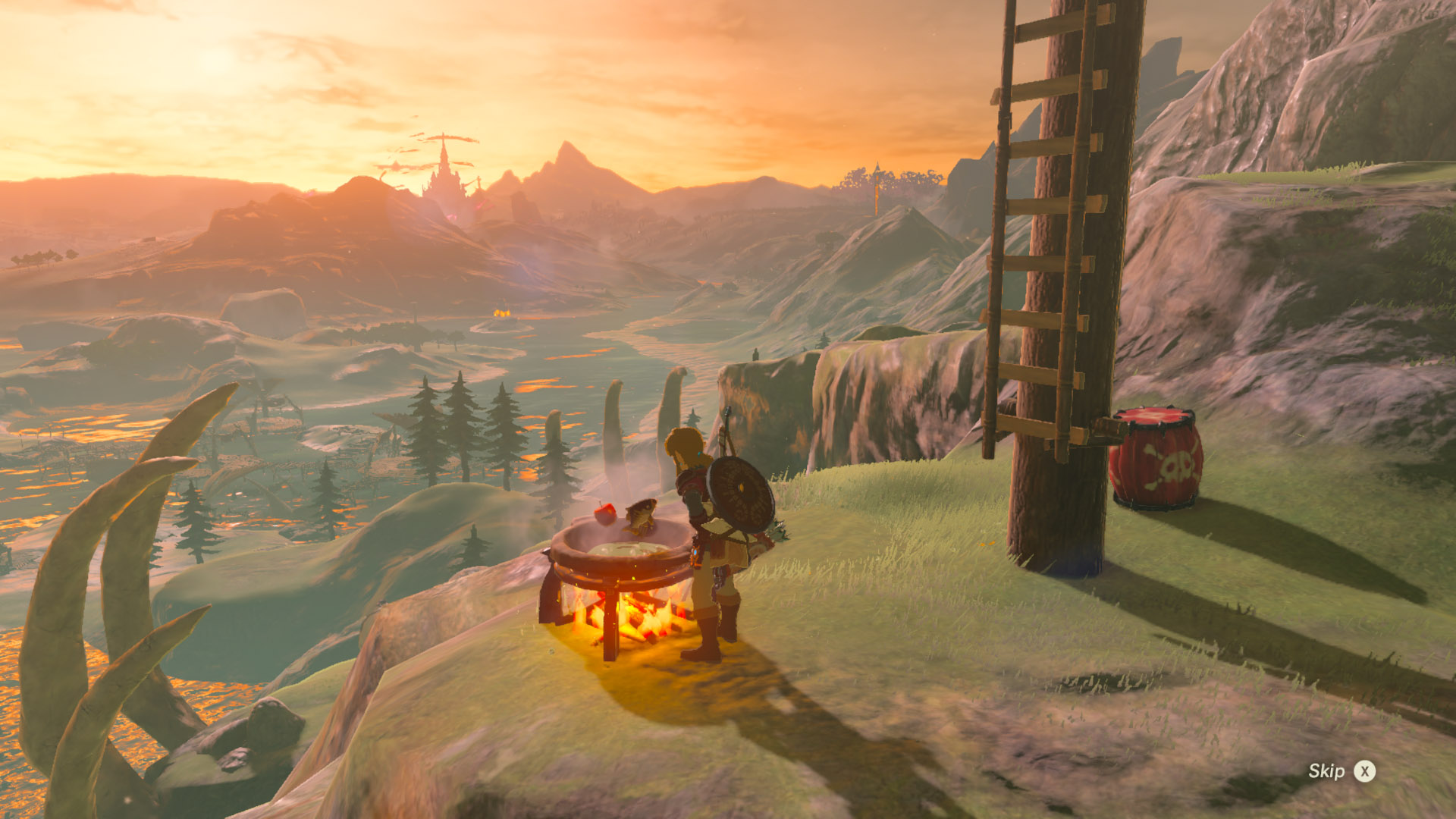
There is no cooking tutorial but each ingredient or monster part has a description which will give you a hint on what it does (it follows a simple logic). Once you figure out the rules for cooking you can prepare all the meals and elixirs you will need on your adventures. While trying you might end up preparing a 'Dubiously looking food' (that is actually edible).

In order to survive in the wilderness you will also need to learn how to fight. At first just picking up a tree branch and beating up Bokoblins with it will be good enough but for stronger enemies you may need to either come up with a combat strategy or learn how to parry. You have access to melee weapons and ranged weapons (just bows). There's a wide variety of them and you will always want to have certain types in your inventory. The inventory slots are very limited. There is a way to get more but at a cost - you need to find the creature that can give you more slots in exchange for Korok leaves that can sometimes be hard to find (mini puzzles).

Verdict

Breath of the Wild feels definitely like a Zelda game even though it is vastly different. It feels more like playing a game from decades ago when you were simply thrown into the game and it was up to you to figure out what to do and where to go next. There are no endless tutorials and you don't need to blindly follow a scripted story. Instead you are free to roam a huge open world and if you wish you can complete the 5 given main quests one day. I highly recommend doing the Divine Beast quests because those are nice little dungeons. The world in Breath of the Wild has its mechanics and it is up to you to adapt. While Link doesn't get any better in terms of stats for example, it is you who gets to know the world and mechanics better. The more you discover the easier is to survive. If by a chance you haven't played this game yet, go get it and play it.

And if by a chance you can't play BotW just yet, go visit Breath of the Wild world in VRChat. Honestly, the way how the game works this would be great in virtual reality. Doing backflips wouldn't probably work but there are many things that would work and I treated the game more like a VR one rather than a traditional one.

Ren (stsungjp on Twitter)

Friday, November 25, 2022

Stray

Stray was a long awaited game by many cat lovers including me. When you first start the game you are shown a stray cat from the 3rd person. You can control it and your first task is to play with the other strays that are in the area. After watching several beautiful playful scenes including these kitties you embark on what seems to be a routine daily journey hopping from one pipe to another. At one point though the cat falls and lands in what seems to be an abandoned city. It turns out to be not so abandoned as the cat will encounter humanoid robots with human behavior. Your task is to get back to the Outside from which the cat came. The cat is joined by B-12 drone that helps the cat and the player to reach the goal.

Stray is a straightforward platforming game that includes several puzzles and offers additional sidequests. While the story and gameplay may be simple, the game bursts with life and cuteness even in this cyberpunk devastated and mostly abandoned city. You explore the world and discover more about the city and its history - about what actually happened.

While roaming you can also simply be a cat, you can scratch rugs, walk over keyboards, nuzzle robots, run under their legs, knock objects off, meow or simply sleep.

The platforming part is rather easy, you simply follow directions that the game provides in cues that are more or less noticeable and if you need help all you need to do is ask your companion robot. You use spacebar to jump and the cat does it automatically meaning that if you are really bad at jumping like me, you don't need to be afraid of playing the game. On the other hand it also takes the effort from you and for some this can be a downside as well. There are several chase parts in which you have to run and avoid mysterious creatures though.

The visuals of the game are wonderful. All the environments are nicely crafted. The combination of dark city with its neon signs blinking and with nature creeping in is wonderful to watch. The lightning all this creates is perfect for really nice shots but sadly cats don't take selfies.

The animations are what breath life into the game. This mostly applies to the cat itself. If you ever had a feline companion at home you will be able to see how truthful the digital cat's behavior is. You can truly feel like a cat playing this game.

Verdict:
Stray is a short (several hours long) puzzle platformer game that puts you in a role of a cat finding a way to its home territory. The game has a simple linear story but offers two open environments to be explored. The game is played from the perspective of a cat meaning that in order to traverse these environments the player needs to think like a cat - spotting a ladder and wanting to use it is not what a cat would do since it can simply jump. The player is free to behave like a cat and some of these cat activities will need to be used to solve puzzles in the game.

Recommended to anyone who just wants to enjoy a very well crafted beautiful game featuring a feline protagonist.

Ren (stsungjp @twitter)

Friday, September 30, 2022

Dyschronia: Chronos Alternate Episode I

Dyschronia is one of the games that caught my eye at TGS and there isn't many games that make me want to buy them on day 1, especially if they are for Quest (yay for my 1st review on this store). Since the name also involves 'Time' in it I expected a game featuring time travel and was very interested in how that would feel in VR, and the game delivered that.

The game takes place in an artificial marine city named Astrum Close where citizens are guarded from the contaminated outside world. All the citizens are connected via what is called Augmented Dreaming. Everyone shares their feelings there and whenever someone starts to feel bad a Supervisor can help them feel better. This way everyone lives in peace and crime practically doesn't exist - until day 1 of you - Hal Scion - being named a Special Supervisor. The city goes under lockdown when the city's founder is found dead, murdered. Hal is assigned to lead the investigation. Hal has a special ability that allows him to view memories linked with items he touches. Thanks to this ability you will have the ability to find information no one else can. These information though still need to be proven in order to be used at trial.

While the player is free to roam, the game progresses in a linear way. You could say that this game is a visual novel, but it is in 3d, in virtual reality, and you are the protagonist. It is a totally different experience and very immersive one. The story is very compelling. It may seem simple at first but with all the information you uncover, you will come to understand that there is way more going on than just 'almost impossible murder'.

Dyschronia also features one short 'stealth' part which is a nice refreshing - or frustrating - moment. It was handled very well from my point of view since it didn't feel forced but rather something you'd expect from that kind of situation.

The game play this is very easy, you walk around, talk to people by touching speech bubbles, scan objects, grab them, use them etc. You can also give headpats to Lily, little cute robot. The controls are simple and easy to use but they are meant for a right handed person and there does not seem to be a way to switch them to the left hand. The game offers free locomotion that is rather slow, teleportation and hybrid locomotion.

The graphics of the game are very good, the ideal kind that doesn't age (think Playstation 2 cell shaded Japanese RPG games) with time. The UI is stellar. I've played many games but this is probably the first game that made the UI feel like part of the world (which it is part of). It shows how we could actually use AR in the future - or at least how other games could use it. It added a lot to the immersion.

As for sound, there is music playing during the whole time which could make it less immersive for some. The music is beautiful but unfortunately is very loud compared to the character voices, especially when they are standing a little bit further away. I liked the voice acting a lot (Japanese), but sometimes it seemed to me that Hal was taking ages to say 'hmph' or something like that and these were always way louder than his usual speech level.

The only downsides of the game for me were constant load times (because of playing it on Quest?), floating in space (needing to recenter often) and sometimes not being able to hear what a character standing further away was saying. Apart from that, a truly amazing game.

Verdict:
Dyschronia is a story-driven adventure game, more of an immersive experience, in which you will truly become a Supervisor investigating a murder. The level of immersion is unlike from any other game I played. There is so much done right in this game, well chosen and done graphics, UI, story, characters, time travel. I highly recommend the game for the story and immersion to anyone who likes to experience being in someone else's shoes and just go with the story.

The game is much better than my review may make you think it is!

Big thanks to the developers. I can't wait for Episode 2 and 3. And thank you for thanking US.

Ren

Wednesday, September 21, 2022

DJMAX Respect V

I was introduced to DJMAX what seems to be ages ago when a rhythm game player came to me and asked if I can try the game out. I was like 'sure, why not'. What I did not know was that he let me play the hardest song in the game and see how I'd do. I cleared the song to his astonishment. I asked what the game it was and that is how I discovered DJMAX. It became one of my most played games on PSP.

Wait, another vertical scrolling rhythm game?

DJMAX is a game that had a very big following and could have reached mainstream if it was released on more platforms earlier. That decision came rather late. Relatively recently DJMAX made it to PC, that is with DJMAX Respect V. DJMAX is a vertical scrolling rhythm game with several button modes. You can start with 4 button play, progress to 5 buttons, then 6 buttons and eventually end up playing 8 buttons. Apart pressing the regular buttons there might appear a slide note from time to time, there are two slide notes (mapped to Shift keys on PC) and they add little bit more complexity to the game. Since this is a game that was meant to be played with d-pad and buttons the song charts are made the way that it is possible to play them with these - players used to play rhythm games meant for keyboard play may wonder why there's just certain combinations used in the charts.

There are long notes in the game that you need to press as well, just hold them and release them on time. Each note be it a regular note or long note are being judged - you get judgment from 1% to 100% depending on how close to being on time you were. The timing windows are actually huge which makes it easier to hit a note (if you miss by a chance you can just press it again to still hit it).

The timing in the game is very lax (feels even more lax compared to the PSP games). It is the combo, as in many Korean games, that counts the most with you keeping max Fever going. There is a Fever bar that fills with each note confirmation, when it gets full you need to activate it to get a 2x multiplier. Then you continue to fill it again. When you fill it and activate it in time you get a higher multiplier for everything (3x). The maximum multiplier you can get is 5x which will stay for as long as you manage to fill the bar and activate Fever in time.

Each song has a difficulty shown in stars. It ranges from the easiest 1 to the hardest 15 for the 'playstation control' charts. There is another scale marked SC which is meant for keyboard play and starts around 3 and goes to 15 as well and will introduce a playstation player to more patterns and chord combinations making it even way harder - a PC VSRG player will find these SC difficulties more familiar. Note that a SC 3 charts is more like playstation 8 in terms of difficulty.

There are several modes in which you can play, there is Air that lets you play a randomly chosen song or just watch and comment on it. There's Freestyle mode where you can pick any song you want and get the best score. Then there's Online play where you play against other players either using a ladder system or just playing for fun. Lastly there is Mission mode in which you complete a set of songs with certain modifiers or conditions.

So much music
DJMAX offers a wide range of music styles. Many of the songs may be new to non-rhythm game players but there is a lot to choose from and the music is good. For rhythm game enjoyers there are DLCs from previous versions of the game including Technika but also from other rhythm games like Chunithm, Deemo, Muse Dash, Groove Coaster etc. The base game gives you over 150 tracks (there are free tracks added from time to time). All these songs have music videos that you can unlock and watch in the game as well.

DJMAX has style
Korean games tend to look great and DJMAX is not an exception. It looks simply great. It has a great style, and not just one. You can unlock more skins and also customize the look of in-game when you are actually trying to read the charts and pressing buttons. Not many games can rival the look of this game.

In order to unlock customizations including songs you need to fulfill certain criteria. There is a lot of achievements to get in the game and are neatly presented to you. Some may seem impossible to get but when you get them you will feel rewarded. There is no other game that motivated me enough to actually hunt the achievements!

Not everything is great...
DJMAX is a great game that offers a lot to the player but unfortunately there are few things to note. First the game uses anti-cheat Xigncode which requires an internet connection. There is no way to play the game offline or with a bad internet connection. Second thing to note is that the game is very expensive. To this date the total of the game including DLCs would total for me to 388EUR. It is for a lot of content though but there is even more content that is behind a paywall. Each season you can get 'free' stuff, even a skin if you finish all steps. That you can only get if you get a battle pass though. You can even pay for it to automatically unlock at the end of the season. Means throwing a lot of money at Neowiz.

The last thing I'm not fond of is the fact that Steam achievements expect you to have those expensive DLCs. Perfecting this game means a lot of money spent.

Verdict
You can clearly see that DJMAX was created with love. It has everything players could possibly hope for in a rhythm game. It is beautiful to look at, offers 150+ songs of various genres, has different button modes and game modes and gets many DLCs with more great music. So far it may be the only game coming from a different platform that runs without any issue on PC. Unfortunately the game needs constant internet connection and is rather expensive.

I can highly recommend this game to anyone who likes to press buttons at high speed.

Ren

Sunday, May 8, 2022

Moss Book 1

Moss VR is originally a Playstation title developed by Polyarc and the game was released in 2018. Moss is a VR puzzle adventure platformer but unlike most of VR games it is played from a third person perspective - which turns out to be your own perspective.

The game starts with you reading a book introducing you a fairy tale like story, eventually taking you into the story itself. Moss is a fully narrated story that makes you part of it. You play as Quill, a cute little mouse, full of enthusiasm. She finds a shard that calls a human sized ghost-like masked creature, a guardian angel of sort. This being is also you. You watch over Quill as she goes on her journey to save her uncle and the kingdom from an evil fire-breathing serpent.

Moss is a simple game that requires a bit of platforming. You control Quill and walk her through beautifully crafted environments that are joy to look at. The environments are single scenes and you have to walk from the place you appeared to the other end of the environment. Sometimes you can just freely walk through but mostly you have to solve an environmental puzzle to get to the other side. These get more and more complex as you progress and they require the intervention of you as the guardian. In the later stages of the game they can also span several 'scenes' and not just one.

You control Quill with joystick and buttons to jump and attack like in a traditional game. The guardian though has 'hands' - blue orbs. Those are where your motion controllers are so you can reach with them and physically move objects around, stall enemies, drag them around. You can also pet the mouse on the head, high-five her when she presents a hand or heal her when she takes damage by holding her for a while. You can even spook her if you wish to. It truly feels like you are a magical being doing magic.

There is some combat but it is fairly simple. At first you just hack at the enemies but later on you will find you that you can stall enemies, move them around (so they explode elsewhere), you can even shoot with the enemies you currently hold in your blue-orb hand. In some areas of the game there will be big fights requiring you to multitask a bit with both of your hands while still moving Quill around (stalling an enemy while controlling Quill and attacking the held enemy for example). This most probably is not necessary but adds more depth to the game and to me it felt natural.

Moss is a game that is about immersion and they did an excellent job at that. The game proves that in order to be immersed in a game you don't need a first person view. The environments are rich and beautiful and I spent a lot of time just looking around and waiting for things to happen. I was so curious that I also spend some time walking around and peeking around every corner. This way I also found out that there are hidden items you can collect (scrolls) that are often somewhere where they are either hard to reach or they are hidden if you are just sitting in the middle of the scene.

The sound is also excellent. There is everything you'd expect and the sound is also 3d. The sound effects are well chosen and they seem to be real be it a turning of a heavy page from the story book at the beginning, Quill's squeaks or her steps. You will hear background noises perfectly matching the environments (or not because it will feel so natural). Stop and listen to the sounds. You will discover how well the sound was done.

Verdict: Moss is a game that provides a unique experience that only VR can deliver. Moss is one of the most immersive games I played even when the game is played from a third perspective. The gameplay is on the simple side but it also means that the Moss is a great game to introduce people to VR and gaming in general. The only downside is that the game is rather short. You can finish the game in 3 hours and be little bit disappointed in how suddenly it ends. If you enjoyed this game and crave for more there is a sequel already out for Playstation VR and soon to be released for Quest.

Ren (stsungjp on Twitter)

Wednesday, April 20, 2022

Audica

Harmonix is a studio you probably heard of already, which can't be said about most VR games studios. Harmonix is known for games like Amplitude, Rock Band, and Dance Central. All these games are rhythm games that became popular, and we even got a VR version of Rock Band and Dance Central. When Beat Saber, the first VR rhythm game, was still the hype, Harmonix released their new VR game named Audica (2019), but it may have been shadowed by the lightning saber slashing game.

Audica is a rhythm game that will make you shoot color-coded notes in time with the music. This may sound simple, but in practice, it is more complex. You will be standing in the middle of a beautiful environment in outer space. In front of you (or around), a colored vortex will appear quickly, turning into one of several types of notes represented by a white symbol. Also, depending on the type of note, a shape will appear around that note. It will quickly shrink, eventually becoming one with the note itself - that is the time you have to shoot the note to get a perfect score. Apart from normal notes, there are sustain notes that you have to hold the trigger, chain notes that you have to keep and follow the chain and slot notes that require you to hold your weapon horizontally or vertically. There are also melee notes that you have to hit with the blades attached to your in-game weapons.

The game's learning curve is steeper than any other VR rhythm game I played. Even though in VR, many things are simplified to make it easier and more fun for the player, Audica requires different skills to even play this game, which is why it may be challenging to get into Audica at first. If you haven't acquired these skills in other games, you might struggle at first since you will have to learn one, two, or all skills required. Shooting games often have some kind of aim assist that makes it easier to hit (they provide more giant hitboxes, even if you miss what you actually see, the hitbox may still be hit and counted, thus confirming the note). As for the other aspect, timing, the games usually provide a wider window for you to confirm the note or use a different way of judging. The most challenging skill you will need to learn is reading, which can take some time.

Audica offers 4 different difficulties and campaigns that will take you through the songs, from the easiest to the most difficult ones. The campaign will require you to get a certain amount of stars in each section before you can advance. Some of the songs have modifiers, making them harder to pass or more fun, but you may skip a song if you do very well on the other songs.

Audica judges your precision in two aspects - aim and timing - and you will be able to see more information about that on the result screen. A scoring system awards you a base score + another score depending on how accurate you were up to 2000 for a single note. Each song has thus a different maximum score. If you keep a streak after every ten notes, your score for a note gets multiplied by 2x, later by 3x, and if you still keep the combo going by 4x. Whenever you miss a note, the multiplier goes down by 1, which is unique to rhythm games as they usually reset.

The game features leaderboards, a single one per song (and also total one). The highest score gets shown there no matter the difficulty. You may not do that well on Expert, which can give you a maximum score, but if you get a nice full combo on Advanced, this score can be higher than the Expert one and will be shown on the leaderboard. This is another feature that makes the game more friendly to the players.

The music in Audica is relatively varied, offering 33 songs plus an additional 4 songs - album versions. You can buy several DLCs, but even if you don't, you can play way more songs in the form of custom songs. You can play this game for hundreds of hours! The game has a lovely community of people that create assets for the game and maps. The maps are enjoyable to play but will require a higher level of play than what is necessary for the vanilla game (not counting Highway to Oblivion on Expert, which happens to be a fierce song and closest to Expert custom song levels). After beating the campaign on Expert, you may find out that your skill still needs to improve to play customs.

The mapping in the vanilla game is good from my point of view as a beginner, but after playing some custom songs, I can see the potential of custom maps - there are great ideas people incorporate into their maps, and they will make you stare at the notes in awe.

An Osu! to Audica converter also exists, which is not actually bad, but you have to pick certain specific maps to convert to get the best experience. Players can find the best maps from around five star songs, but those will become more significant difficult than what can be seen in the vanilla game. Some of these maps provide a good shooting exercise as the songs have higher note density than Audica maps.

This is the only game that made me go 'wow.' The open space, particles, animation, and effects are great. The UI feels bland compared to it, but it works.

Verdict: Audica is a unique rhythm shooter game in VR. It is a fully finished and polished game designed to be fun for casual and competitive players. It can remind you of Osu! in VR, and the ability to play Osu! will actually help you get better way faster. While the game's learning curve is steep for those not invested in rhythm games, the developers made sure to make the game as friendly as possible. Aspects such as user-friendly timing windows, aim assist, maps getting progressively more complex, well-done campaign, leaderboards, settings to help you read well, etc. It has a friendly and active modding community that keeps the game alive, so there is a lot of content worth the money Audica costs. I can highly recommend this game to anyone who is not afraid of learning or hitting a wall in a game.

Ren (stsungjp on Twitter)

Tuesday, January 11, 2022

AGAINST VR

AGAINST is a VR combat rhythm game from a Russian studio Joy Way that you might have already heard about because of their earlier VR parkour game Stride. If Stride is a VR version of Mirror Edge then AGAINST would be a combination of Pistol Whip and Beat Saber (even though there seems to be another game with similar concept named Cybrid).

The game currently offers a tutorial and a campaign consisting of 7 levels and credits. It tells a story of Detective John Black trying to track down and defeat an evil scientist Doctor Vice. The story is told in several comic strips between levels which are nice but don't tell a coherent story.

You as Detective Black will will be encountering enemies that will attack you with different weapons - a crowbar, revolver, tommy gun, brass knuckles. Four weapons will also be available to you too - a sword, a revolver, tommy guns and brass knuckles. You will have to touch the weapon in order to equip it and then you can use it to slash, shoot, punch you enemies or deflect bullets.

Sometimes you will also have to avoid attacks. Throughout the levels there will be obstacles you'll have to avoid, either stationary or moving (airplane shooting at you). You might encounter arrows that if you swipe you will move to the side or jump high etc. If you miss these you might be overrun by a car, hit a wall or simply take an alternative route.

Visually the game is beautiful but very different from what I expected. The beta version had a film-noir look which I really enjoyed. The developers decided that this may have not be the best idea so they changed the look considerably. The game is not as dark, is more graphically detailed, smoother, and red. This makes the game not look as violent as it is.

Each level is designed differently, following the story which is nice, and features a final battle or a boss. The levels are 3-5 minutes long and have 3 difficulties - Easy, Normal and Hard.

The game is described as a rhythm game and there is a rhythm game aspect in it. The enemies have to be hit or bullets deflected on time with the music's beat. Unfortunately the levels are not perfectly on sync. In fact it seems that the individual 'notes' are off in each level even which may be due to the fact that each enemy has an animation during which there is the perfect hit window that does not last long. This may be the biggest problem of the game currently and maybe even in the future. This makes creating custom maps way more difficult for mappers that can keep the game alive. There is no possibility to change audio settings currently which is pretty bad for a game of this kind.

Replayability of the game is something to be seen. So far you can finish the game in 35 minutes if you are a player used to playing rhythm games or active VR games. After that you might want to replay to see if you can get better scores and place higher on the leaderboards. Unfortunately the sync is off so this may rather make you want to stop playing the game immediately.

There are custom maps that you can download from https://againstmaps.com/ and beat map editor which you can use to create your maps. The mapping currently is bad since people are trying to figure out what can work. Playing some of the faster songs I realized that this game has some limits. While games like Beat Saber can just throw notes at high density, this game can't due to the rather long animations and size of the enemies. Players will have to find how to be creative to create distinct fun levels and also will have to figure out how to time each 'note' because the animations make it impossible to time them well without finding a correct offset for each of the enemies.

Will this be another forgotten and abandoned game with great concept by this studio or will they keep it alive? Will the community keep the game alive?

Verdict: AGAINST is a game that combines several concepts together and for me that worked pretty well but for many this can also be a reason why not to play the game. Visually it is pleasing, the story is short and nothing awesome but not bad either. The game will make you move with one arm and squat quite a lot which is always nice. The combat part of the game is solid if you welcome variety. Unfortunately as a rhythm game this fails due to the songs not being on sync. Games like this aren't often played by players as they cannot stand that. So far the same is true for custom songs but this may change in the future. If you are someone who can't stand offsync games with no possibility to change offset I don't recommend this game.

Otherwise it is a great experience, even though a playthrough takes 35 minutes.

More work needs to be done on the game. Visibility, sound effects and indicators should be improved apart from what I mentioned. Also a mirror modifier would come handy for those left-handed players like me. Also I played the game with knuckles controllers and the settings for the controller are wrong so it's quite a pain to play the game with these controllers.

Ren (stsungjp on Twitter)